Warren Buffett's Strategic Investments in Japanese Companies: The Complete 2026 Guide
Originally published December 28, 2025 · Updated May 6, 2026
Overview: A $30 Billion Bet That Rewrote the Playbook
Warren Buffett's Berkshire Hathaway has dramatically increased its stakes in Japan's top trading houses, marking one of the most significant international investing moves of the decade. As of 2026, Buffett's combined holdings in these five companies are worth over $30 billion — a substantial portion of Berkshire Hathaway's global equity portfolio and, notably, the largest international equity bet the company has ever made.
What makes this position remarkable is not just its size but its structure. Buffett didn't simply wire dollars to a Tokyo brokerage. He built a sophisticated currency-hedged position using yen-denominated bonds, effectively borrowing in Japan to buy Japan — a move that signals exactly how deliberately this entire strategy was constructed. This guide breaks down what Buffett owns, why he bought it, how the financing works, and what retail investors can actually do with this information.
Ownership per company: ~8.5%–9.8% (approaching the 10% regulatory ceiling)
Initial purchases disclosed: August 2020
Holding horizon stated by Buffett: Decades — comparable to Coca-Cola and American Express
What Is a Sogo Shosha?
To understand why Buffett bought these companies, you first need to understand what they are — because they have no real equivalent in the Western business world. A sogo shosha (総合商社) is a Japanese general trading company, but that description dramatically undersells what these entities actually do.
Unlike a Western commodity trader or logistics firm, a sogo shosha is a massively diversified conglomerate with equity stakes in hundreds of businesses across every major industry. They source raw materials, move goods across supply chains, finance transactions, invest in infrastructure, develop real estate, and take long-term ownership positions in both suppliers and customers. Think of them as part investment holding company, part global logistics network, part commodity trader, and part merchant bank — all rolled into one structure with century-long business relationships on every continent.
The five major sogo shosha generate revenue from energy, metals, food, chemicals, machinery, finance, and technology. Their diversification is so extreme that no single commodity cycle or regional downturn can meaningfully threaten the whole. That structural resilience is a core part of what attracted Buffett — these are businesses that have survived world wars, oil shocks, currency crises, and financial panics and kept paying dividends throughout.
Which Japanese Companies Does Buffett Own?
Buffett's Japanese investments are concentrated in the five largest sogo shosha, each holding a distinct but overlapping portfolio of global businesses:
- Mitsubishi Corporation — the largest by revenue, with major positions in energy, metals, and food across more than 90 countries
- Itochu Corporation — particularly strong in consumer goods, fashion, food retail, and the China market; widely regarded as the best-run of the five
- Mitsui & Co., Ltd. — deep exposure to energy infrastructure, iron ore, and chemicals; significant presence in Australia and the Americas
- Marubeni Corporation — major positions in grain trading, power generation, and agribusiness globally
- Sumitomo Corporation — strong in metals, infrastructure, and media; known for disciplined capital allocation following a major commodity loss in the 1990s that fundamentally reshaped its risk culture
Berkshire Hathaway holds around 8.5%–9.8% ownership in each company, with regulatory filings showing stakes approaching the legal limit of just under 10% per firm. Buffett has publicly indicated he would be open to holding more if Japanese regulations permitted.
Itochu Corporation: ~9.6%
Mitsui & Co.: ~9.8%
Marubeni Corporation: ~9.7%
Sumitomo Corporation: ~9.7%
Why Did Buffett Buy Japanese Trading Houses?
1. Classic Value Investing at a Global Scale
Buffett's entry in August 2020 was timed after years of Japanese equities trading at depressed valuations relative to Western peers. The five trading houses were profitable, dividend-paying, globally diversified businesses trading at price-to-earnings ratios that would be considered deeply cheap by any standard. For a value investor of Buffett's discipline, they represented the kind of obvious, patient opportunity that is increasingly rare in mature markets.
2. A Structural Shift in Corporate Japan
Japanese companies spent decades frustrating international investors with poor capital allocation — hoarding cash, maintaining cross-shareholdings that depressed returns, and resisting shareholder pressure. That began to change meaningfully around 2015 with the introduction of Japan's Corporate Governance Code, and accelerated sharply through 2023 and 2024 when the Tokyo Stock Exchange actively pressured companies trading below book value to improve returns. The five trading houses responded with substantial dividend increases, aggressive share buybacks, and more transparent capital allocation — exactly the shareholder-friendly behavior Berkshire rewards with long-term ownership.
3. Commodity and Inflation Exposure
Each of the five sogo shosha has deep roots in commodities — energy, metals, agriculture, and chemicals. In an environment of persistent inflation and supply chain restructuring following the COVID era, these businesses benefited significantly. Their global sourcing networks and long-standing supplier relationships gave them pricing power and margin resilience that purely financial businesses lacked. For Berkshire, which had relatively limited direct commodity exposure, the trading houses provided a meaningful inflation hedge.
4. Diversification Away from U.S. Dollar Assets
Berkshire Hathaway is overwhelmingly a U.S.-centric portfolio. Japan represents genuine geographic diversification, and the yen provides exposure to a currency and economy that moves independently of U.S. monetary policy cycles. For a company sitting on hundreds of billions in assets, that independence has real portfolio construction value — particularly as U.S. equity valuations have stretched to historically elevated levels.
5. Steady, Growing Dividend Income
All five companies pay meaningful and growing dividends. Given Berkshire's scale, the annual dividend income from these five positions alone runs into the hundreds of millions of dollars. For a company that cannot easily deploy all its cash into U.S. equities without moving markets, a reliable international dividend stream has real practical value beyond the capital appreciation story. The carry from dividends exceeding yen bond interest costs makes the position self-funding in an important sense.
The Yen Bond Strategy Explained
One of the most sophisticated aspects of Buffett's Japan position is how he financed it. Rather than converting U.S. dollars into yen and buying shares outright, Berkshire Hathaway issued bonds denominated in Japanese yen — effectively borrowing in Japan at Japanese interest rates to fund Japanese equity purchases.
This creates a natural currency hedge. If the yen weakens against the dollar (as it did dramatically between 2021 and 2024), the cost of repaying those yen-denominated bonds falls in dollar terms, partially offsetting any reduction in the dollar value of the equity holdings. Conversely, if the yen strengthens, the equity gains more value in dollar terms, partially offsetting the higher bond repayment cost.
Crucially, Japan's interest rates have historically been among the lowest in the developed world. Borrowing in yen gave Berkshire access to financing at rates far below what it would pay issuing dollar-denominated debt in U.S. markets. The dividend yield from the trading house shares has consistently exceeded the interest cost of the yen bonds — meaning the overall position generates positive carry from day one, before any consideration of capital appreciation.
Proceeds purchase trading house shares paying higher dividend yields
Result: positive carry (dividend income exceeds financing cost) + natural FX hedge
Yen weakens → bond repayment cheaper in USD, partially offsets equity value decline
Yen strengthens → equity worth more in USD, partially offsets higher bond repayment
How Has the Position Performed?
Buffett's initial purchases were made in 2019 and publicly disclosed in August 2020 on his 90th birthday. At that point, the five stakes were worth approximately $6 billion combined. By 2026, the combined value has grown to over $30 billion — a return of roughly 400% on the original cost basis, driven by share price appreciation, yen bond carry income, and reinvested dividends.
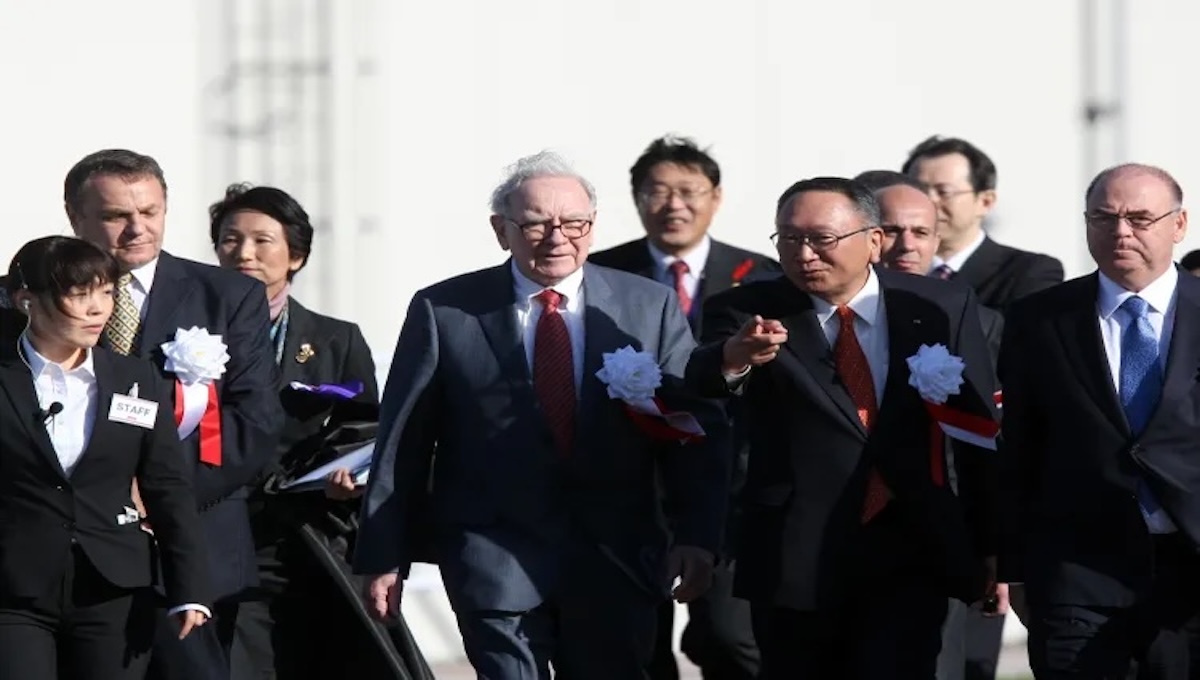
Buffett visited Japan in April 2023 — his first international trip in years — meeting with executives from all five companies and publicly reaffirming his commitment to holding and potentially expanding the positions. That visit was widely interpreted as a signal that the investment thesis remained fully intact and that Berkshire had no intention of trimming. Subsequent regulatory filings confirmed continued stake increases through 2024 and into 2025, with holdings in each company steadily approaching the 10% ceiling.
What This Tells Us About Buffett's Broader Worldview
The Japan trade is worth examining not just as an investment but as a signal about how Buffett sees the current environment. He rarely makes large international bets — his career has been overwhelmingly focused on American businesses. The scale and deliberateness of the Japan position suggests that U.S. equity valuations are stretched relative to historical norms, that dollar-concentrated portfolios carry more risk than is widely appreciated, and that patient capital deployed in undervalued markets with improving governance can compound powerfully over decades.
The parallels he draws to Coca-Cola and American Express are intentional and instructive. Those are positions Berkshire has held for 30+ years, through every kind of market environment imaginable. Buffett is signaling that he expects his successors at Berkshire to still be holding these Japanese trading houses long after he is gone — and that the investment case will look even more obvious in hindsight.
How Retail Investors Can Follow Buffett's Lead
Individual investors cannot replicate Buffett's yen bond financing structure — that requires institutional scale and capital markets access that simply isn't available to retail participants. But the underlying equity exposure is accessible to anyone with a brokerage account. Here are the main routes, each with distinct tradeoffs:
Japan-Focused ETFs
The simplest and lowest-cost entry point. ETFs provide diversified exposure to Japanese equities without requiring a foreign brokerage account or direct currency conversion. Key options include EWJ (iShares MSCI Japan ETF), which holds a broad basket of large Japanese companies and includes the trading houses, and DBJP (Xtrackers MSCI Japan Hedged Equity ETF), which offers the same equity exposure but with the yen/dollar currency risk hedged out — useful if you want the business return without the FX volatility. Expense ratios are low and liquidity is high.
Direct Stock Purchases
All five trading houses are listed on the Tokyo Stock Exchange and can be purchased directly through brokerages that offer international trading access. This gives you targeted exposure to the exact companies Buffett owns, with full dividend entitlement. The tradeoffs are currency exposure you manage yourself, foreign withholding tax on dividends (typically 15% under the U.S.-Japan tax treaty, potentially recoverable as a foreign tax credit), and potentially higher transaction costs depending on your broker.
American Depositary Receipts (ADRs)
Several of the trading houses have ADRs available on U.S. exchanges, allowing purchase in dollars through a standard U.S. brokerage account with no foreign trading access required. ADRs carry embedded currency exposure — the ADR price moves with both the underlying share price and the yen/dollar exchange rate — but eliminate the friction of foreign account setup entirely. Liquidity varies by company; check trading volumes before committing significant capital.
Direct Tokyo Stock Exchange purchase: targeted exposure, full dividends, FX risk
ADRs on U.S. exchanges: dollar-denominated, no foreign account needed, embedded FX
Currency-hedged ETFs (e.g. DBJP): removes yen/dollar volatility, pure equity return
Key Risks Every Investor Should Understand
Currency risk. The yen weakened substantially against the dollar between 2021 and 2024. While Buffett hedges this institutionally with yen bonds, retail investors in unhedged positions absorb full FX volatility. A 10% yen depreciation erases 10% of your dollar-denominated return before the stock moves at all. This is not a theoretical risk — it materially affected returns for unhedged foreign investors in Japanese equities during recent years.
Japan's macroeconomic backdrop. Japan's economy grows more slowly than the U.S. and faces significant demographic headwinds from an aging and shrinking population. The Bank of Japan's gradual exit from ultra-loose monetary policy introduces interest rate uncertainty that did not exist when Buffett first bought in 2019. Rising Japanese rates could pressure equity valuations and increase the cost of the yen bond carry strategy over time.
Geopolitical proximity. Japan sits in one of the world's most complex geopolitical neighborhoods — close to China, North Korea, and contested maritime territories in the East and South China Seas. Escalation in the Taiwan Strait or Korean Peninsula would affect Japanese equities disproportionately relative to U.S. or European markets, regardless of the underlying business fundamentals.
Buffett's advantages don't transfer. His yen bond carry trade generates income that subsidizes his equity position in a way retail investors cannot access. His cost basis from 2019 and 2020 is dramatically below current market prices. Investors buying today are entering at valuations substantially above where Buffett paid — the margin of safety is narrower, and the expected return from this point forward is lower than the headline 400% gain might suggest.
The Bottom Line
Warren Buffett's Japan position is one of the most carefully constructed and intellectually coherent large trades of his career. It combines classic value investing principles with a sophisticated currency strategy, targets businesses with structural advantages that are genuinely difficult to disrupt, and reflects a long-term conviction about corporate governance reform in Japan that has already proven correct. The $30+ billion combined stake in Mitsubishi, Itochu, Mitsui, Marubeni, and Sumitomo is not a speculative bet — it is a decades-long commitment from the world's most studied long-term investor, structured to generate income while it appreciates.
Retail investors can access the same underlying businesses through ETFs, ADRs, or direct purchases. Those who do so should enter with clear eyes about the currency risk, the valuation gap relative to Buffett's original cost basis, and the macroeconomic risks specific to Japan. The strategy is sound. The businesses are exceptional. The key variable for anyone following this trade today is patience — and the willingness to hold through yen volatility and short-term noise for the kind of multi-decade compounding Buffett himself is counting on.
Analysis by The Societal News Team Updated 6 MAY 2026
Follow Us!
It helps decentralize our presence across the web and it's completely free!
Instagram ➤
Youtube ➤
Substack ➤
X.com ➤
Telegram ➤
TikTok ➤